


- Navigator
- Southeast
- Business Retention and Expansion (BRE)
- Prospecting and Business Attraction
- State
 It’s no secret: Business is booming in Texas. The state has the world’s eighth-largest economy, supported by a favorable business climate, robust supply chains, major corporate relocations (Apple, Space X, Oracle, Chevron, Charles Schwab, and Tesla, to name a few), and significant foreign direct investment from countries like the United Kingdom, Germany, Canada, and Japan.
According to the Texas Economic Development Corporation, the state has been experiencing significant investment across a variety of industries in recent years, including:
All of this business investment also brings new jobs, and the state has become one of the most popular destinations for both domestic and international migration.
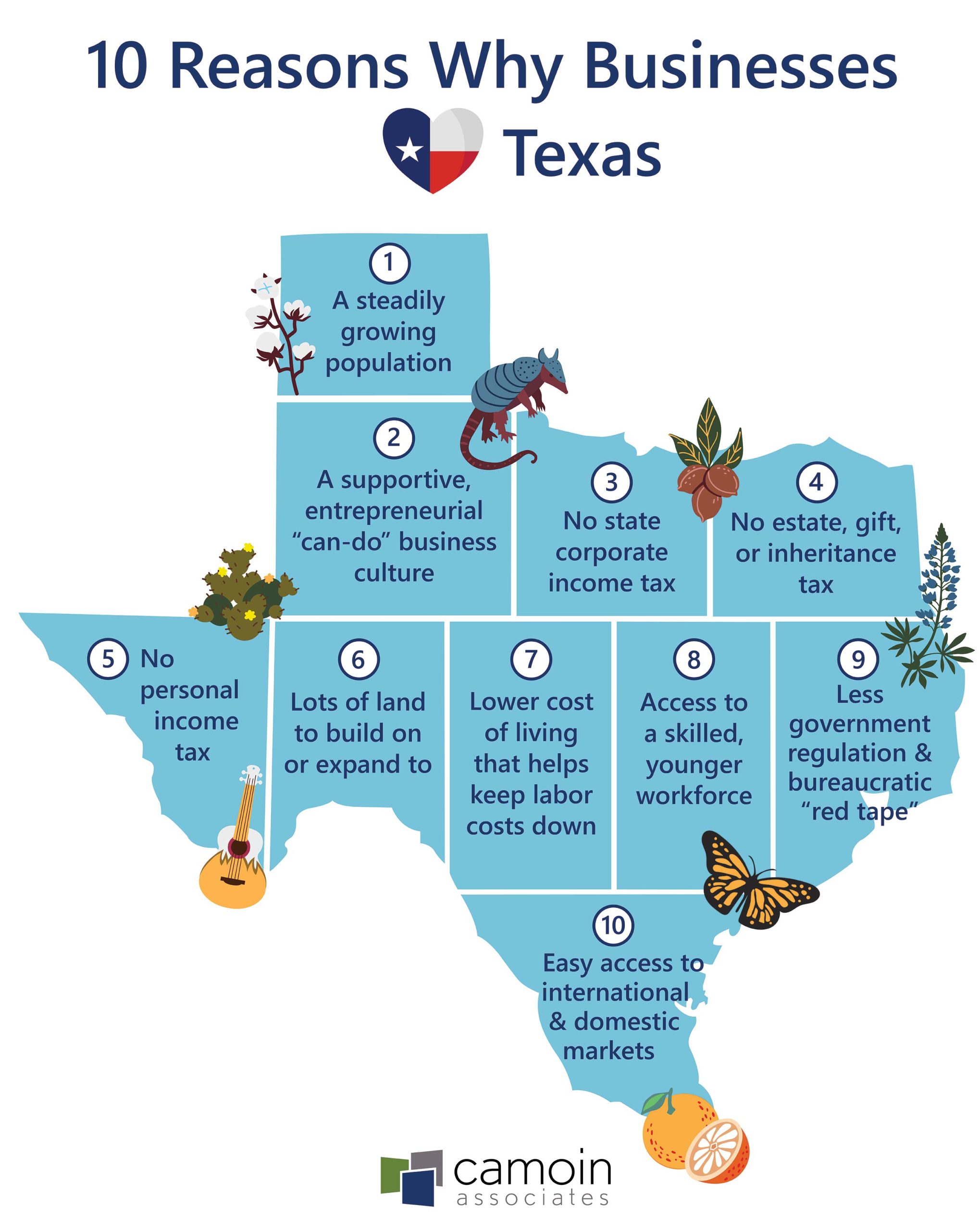 Does Texas Have Any Weaknesses?
No state is perfect, of course, and Texas does have a few challenges to overcome that impact its businesses and workforce, including:
However, these weaknesses obviously do not outweigh Texas’s benefits (at least for now), and the state has remained firmly at the top of economic growth and innovation top 10 lists for years (including our own top 10 list of states with the highest economic momentum!).
Are you looking to better understand your region or state’s economic strengths and weaknesses in order to develop effective strategies for attracting new business investment and a skilled workforce to support that investment? Camoin Associates can help.
Learn about our prospecting and business attraction services
Learn about our Business Retention and Expansion Services
Learn about our industry and workforce development analysis services
Jilayne Jordan is the Graphics and Communications Specialist at Camoin Associates. She spent most of of her 30-year career in the public sector, working for local and state government agencies across three states on transportation, parks and recreation, economic development, affordable housing, homelessness, and small business support projects and initiatives. In 2022, she left the public sector and came to work for Camoin Associates, where she edits (and occasionally writes for) the company’s Economic Development Navigator blog and provides copyediting, graphic design, and marketing services for the firm and its clients. She holds a Bachelor of Arts degree in Journalism with a public relations emphasis from Humboldt State University.
Industry Analytics and Strategy
Following the COVID-19 pandemic, outdoor recreation is no longer in recovery mode and has matured into one of the most significant and durable economic sectors in the country. We take a look at recent trends, opportunities, challenges, and successes in the sector and offer guidance on how to grow your outdoor recreation economy.

Industry Analytics and Strategy
Evaluation and Benchmarking
Your resource for understanding today and looking toward tomorrow