


- Navigator
- Northeast
- Urban
- Real Estate Development and Housing
 In 2025, the City of Albany, NY, partnered with Camoin Associates to complete a citywide housing audit, evaluating market conditions, housing challenges, and the effectiveness of existing policies and programs.
Beyond providing a snapshot of supply and demand in Albany, the final report offers lessons for mid-sized, moderate-growth cities about how to align housing policy with local economic realities while advancing equitable outcomes.
Albany’s challenges mirror those of many moderate-growth cities: When new development is financially infeasible, conventional housing strategies—such as building more supply or imposing affordability requirements—lose their effectiveness.
The key challenge is aligning policy tools and limited public resources with market realities to support new development without compromising affordability for lower-income and cost-burdened households.
Albany’s housing market is characterized by both structural challenges and untapped potential. Limited new development, rising costs, and a growing mismatch between incomes and housing prices underscore the city’s complex market dynamics.
These factors highlight that Albany’s housing challenges are multifaceted, requiring strategies that address both supply and affordability.
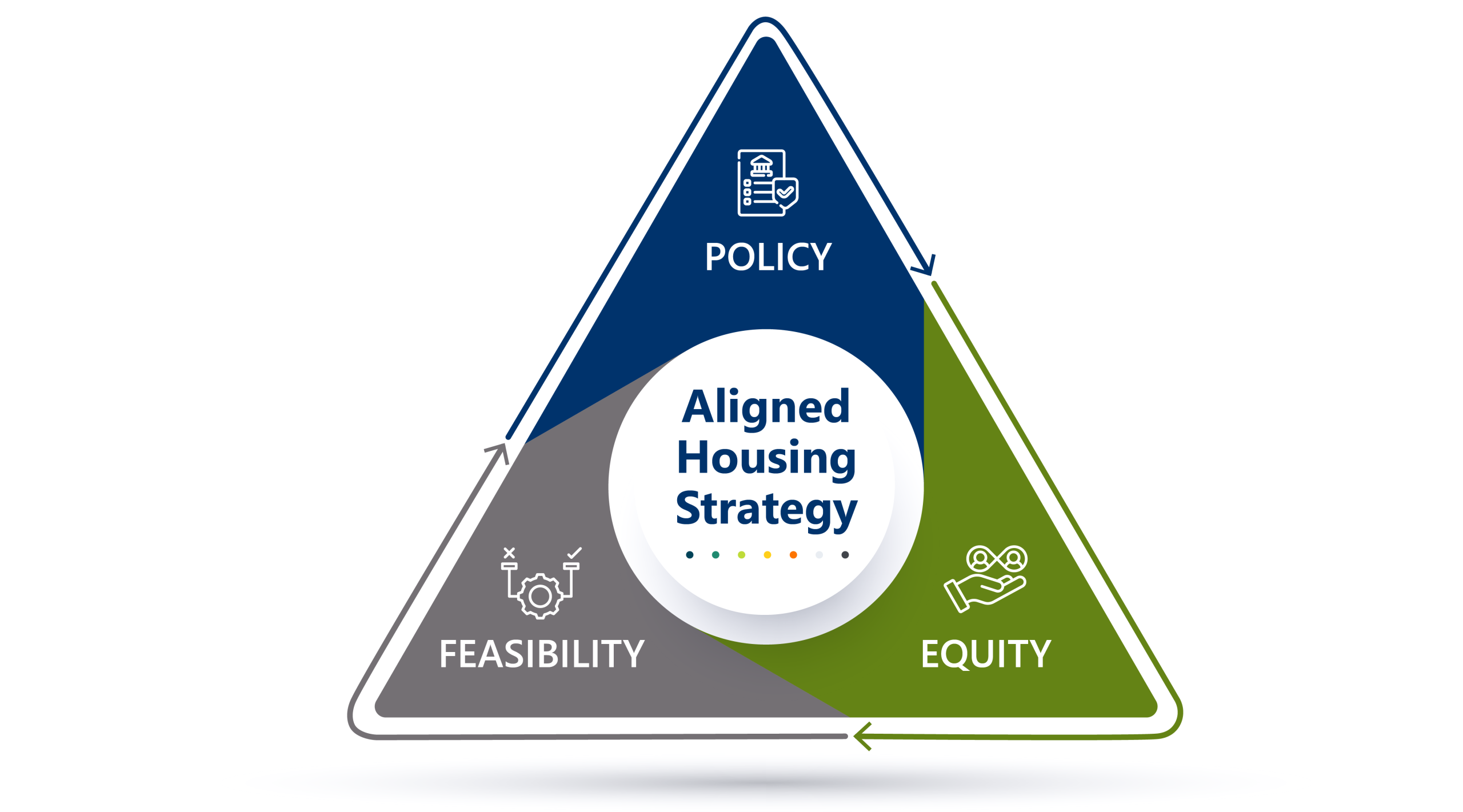 In response to emerging pressures, the City of Albany has assembled a broad housing toolkit, including:
This comprehensive approach addresses preservation, access, and new production simultaneously, but market conditions continue to shape the effectiveness of these tools.
In Albany, large-scale new construction is often financially infeasible. This reality shapes what housing policy can accomplish. Even well-intentioned affordability mandates can make a project unviable if not aligned with local market conditions, limiting their ability to deliver meaningful affordable units.
At the same time, these policies may not always reach the most deeply affordable households, highlighting the need to pair inclusionary approaches with complementary strategies, such as targeted subsidies, preservation, and partnerships with mission-driven developers.
When combined with density bonuses, abatements, or gap financing, inclusionary policies can generate mixed-income housing. When misaligned with market realities, they risk suppressing production.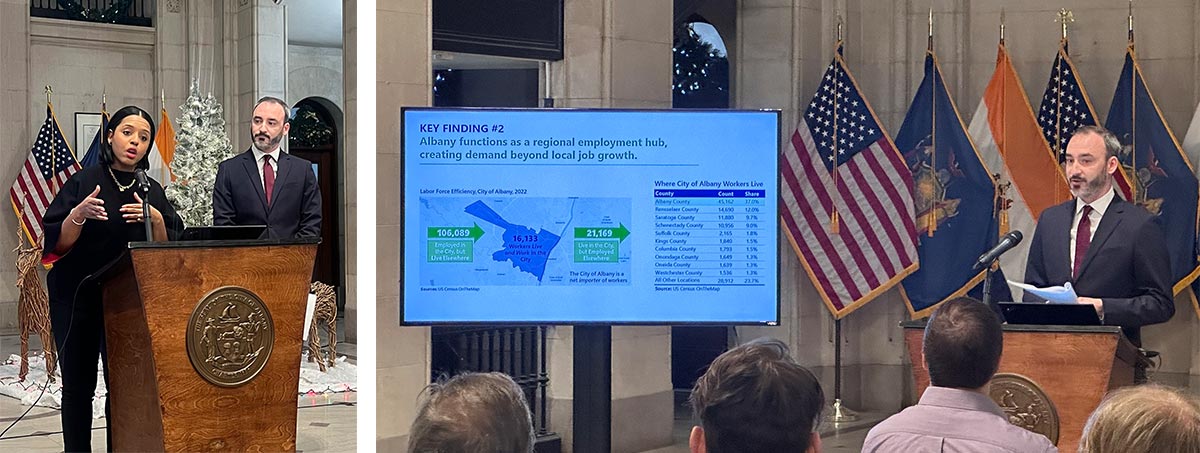
The City of Albany officially released its Housing Audit at a press conference in December 2025, which featured presentations by then Mayor-Elect Dorcey Applyrs and Tom Dworetsky, Vice President and Director of Research at Camoin Associates. The first photo is used courtesy of the City of Albany’s Office of Audit and Control.
The housing audit’s recommendations were shaped by Albany’s fundamental constraint: New housing construction is not financially viable at the scale needed to address demand.
In Albany’s case, the near-term impact will come from reinvesting in existing housing, recalibrating incentives, strengthening partnerships, and encouraging small-scale infill. These approaches address feasibility constraints directly while advancing long-term affordability and neighborhood goals.
Several lessons emerged from our work with Albany that are applicable to any communities navigating fragile markets and constrained resources:
When new construction is financially difficult, preserving and rehabilitating the existing housing stock is often the most realistic and equitable tool for meeting resident needs. Maintaining quality housing, including naturally occurring affordable units, supports existing residents and restores confidence in the market.
Reinvestment efforts can be phased to build capacity. A phased approach, which may include piloting strategies in select areas before broader expansion, allows the City to test tools, strengthen partnerships, and refine its approach.
Phasing efforts in this way helps ensure that improvements benefit existing residents while allowing the City to monitor impacts and adjust as conditions evolve.
Anti-displacement measures, such as affordability deed restrictions, tenant protections, and partnerships with community organizations, should be established early and scaled alongside investment.
Affordability requirements are most effective when tailored to local market conditions and combined with tools that maintain project viability. Strategic use of tax abatements, gap financing, and state or federal funding can help bridge financial gaps and keep developments on track.
Because no single policy can meet all housing needs, these requirements should be paired with other strategies to reach households most in need.
Meeting the needs of extremely low-income households requires mission-driven developers, public land strategies, and coordinated funding streams. The private market alone cannot deliver deeply affordable housing without structured support, highlighting the importance of intentional collaboration.
Housing markets are not static. Assumptions about feasibility, demand, and neighborhood trajectory should be revisited regularly. Policy built for today’s conditions needs flexibility to adapt as those conditions shift.
By aligning policy tools with what the market can actually support, prioritizing the households and housing that are most at risk, and building the partnerships necessary to reach those the market will not serve on its own, cities can make steady, meaningful progress, even when large-scale development remains out of reach.
Read the City of Albany, NY, Housing Audit
Learn about our housing and real estate development services

Industry Analytics and Strategy
Following the COVID-19 pandemic, outdoor recreation is no longer in recovery mode and has matured into one of the most significant and durable economic sectors in the country. We take a look at recent trends, opportunities, challenges, and successes in the sector and offer guidance on how to grow your outdoor recreation economy.

Industry Analytics and Strategy
Evaluation and Benchmarking
Your resource for understanding today and looking toward tomorrow