


- Navigator
- Information Technology, Semiconductors, and AI
- Prospecting and Business Attraction
 It often feels like there isn’t enough time in the day for those working in economic development. You know which companies you should be watching. You know the signals that matter: the hiring surge, the facility permit, and the executive hire in operations. The problem isn’t knowing what to look for. It’s that looking takes time your team doesn’t have, and by the time something surfaces through your normal channels, three other communities have already reached out them. So, what’s the solution?
Agentic AI can’t solve your strategy problem, but it can solve your time problem. For economic development organizations (EDOs) running lean in a competitive field that keeps growing, that’s worth understanding.
Agentic AI refers to artificial intelligence systems that can plan and execute multi-step tasks autonomously, without human prompting at each step. Give it a goal—e.g., research these companies, monitor these signals, or produce this report—and it figures out the sequence of actions needed to get there, executes them, and surfaces the output when it’s done.
This is a meaningful departure from the generative AI tools most of us have been using. ChatGPT and Claude are reactive when used in a standard chat interface. They answer your questions and stop. Agentic AI is proactive. It works autonomously on a task you give it.
If you want to understand the organizational groundwork for getting ready to adopt these tools, Camoin Associates President Rob Camoin, CEcD, covers it thoroughly in his four-part article series, “The AI-Ready EDO: What Leaders Need to Know,” published on our Economic Development Navigator blog earlier this year.
This article picks up where that series leaves off and focuses on what agentic AI workflows look like in practice for business attraction and prospecting teams.
Here’s a quick example of how agentic AI can help your business attraction team:
A company you’ve been tracking posts 14 new manufacturing engineer jobs in a region where it doesn’t currently operate. An AI agent catches it, checks it against your target industry list, finds the company’s Vice President of Operations on LinkedIn, drafts an outreach email, and delivers it to your business development employee’s inbox. The email specifically references the hiring activity and just needs a quick review before sending.
No one on your team set that in motion. The agent was running in the background, doing what you configured it to do weeks ago.
That workflow exists today. The tools to build it are available, most aren’t expensive, and the EDOs that figure this out first are going to find warm prospects faster than those still doing it by hand. That’s the basic case for agentic AI in business attraction. The rest of this article covers what it actually looks like in practice.
The technology question would be easier to defer if the external environment were constant. It isn’t.
Relative to their workload, EDO teams are smaller now than they were 10 years ago. Budget pressures, organizational restructuring, and a growing number of priorities and tasks have stretched staff thinner across more responsibilities.
The expectation that an EDO team can run a full business attraction program, manage a BR&E portfolio, support trade show missions, and respond to active project inquiries simultaneously hasn’t gone away. However, the staff headcount to do it all comfortably often has.
At the same time, the competitive field for any given project has widened. A manufacturer evaluating a new facility location isn’t choosing between three or four familiar competitors. Incentive transparency, improved site data, and the reach of national site selectors mean your community is being measured against regions it might never have appeared on a shortlist with a decade ago. Winning requires showing up earlier, with better intelligence, and with a faster response than the other 40 communities on the list.
Corporate location timelines have compressed, too. Companies that once ran 18-month site selection processes are making decisions in six months or less, driven by supply chain urgency, competitive pressure, and leadership cycles that don’t wait for thorough due diligence. Site selectors are fielding those compressed timelines and passing the pressure downstream. This means EDOs must deliver faster responses and more complete data packages with fewer back-and-forth cycles before a site selector advances or cuts a community from their shortlist.
Perhaps even more consequential on how EDOs spend their time is the fact that companies are now conducting extensive location research before they ever contact an EDO or engage a site selector. They’re visiting websites, downloading incentive guides, looking at labor shed data, and forming impressions of communities well before a request for proposals is issued. By the time a formal inquiry arrives, a shortlist has often already taken shape. EDOs that aren’t capturing and acting on those early digital signals are entering conversations after the real evaluation has already started.
Agentic AI matters in this context not as a technology experiment but as a practical response to a workload and competitive environment that manual processes can’t keep up with.
Most economic developers have used ChatGPT or Claude by now. You type something, and it responds. Useful for drafting, research, and summarizing notes from a site visit. But you’re still driving every single step. Nothing happens unless you ask.
Agentic AI has a standing assignment. Given a goal and the right access, it plans and executes a sequence of tasks on its own, checking back with a human only when a real decision is needed.
A reasonable analogy is that generative AI is a sharp analyst who answers your questions, and an AI agent is that same analyst, but you’ve given them a weekly task, access to the right data, and told them to bring you the 10 warmest prospects every Monday with a draft email for each one. The difference isn’t intelligence. It’s autonomy.
Business attraction is a sequencing problem: Find the right companies, catch them at the right point in their decision cycle, and say something relevant enough to earn a response. Do that manually across a list of hundreds of targets, and things fall through the cracks. Not because your team isn’t good, but because there isn’t enough time or staff to get it all done.
Here’s where an agentic layer actually helps:
An AI agent can monitor job postings, permit filings, press releases, and LinkedIn hiring patterns across your full target list continuously, not just when someone has a spare afternoon. A company quietly staffing up in a new geography is a warm signal. An AI agent finds it while an employee working through a spreadsheet might miss it.
Once signals surface, the AI agent cross-references them against your criteria, industry fit, company size, and expansion history, and ranks the results. Your team works on a prioritized list instead of a raw one.
Who’s the right person to reach? Depending on the company, it might be the Vice President of Real Estate, Vice President of Operations, or someone in corporate development. The AI agent looks it up and populates the record before a human opens it.
This is the moment that consistently lands hardest when working with EDO teams on AI adoption. It’s not simply that the AI agent drafts something. It’s that the draft references the specific hiring surge, a recent expansion announcement, and explains why the timing is relevant. It reads like someone did their homework because, in a sense, something did.
The AI agent records the activity, flags the draft, and passes it to a human for review. Nothing goes out without a person seeing it first. The job shifts from executing all the steps to approving the last one.
The five steps above describe how agentic AI workflows function. What they don’t capture is how differently that function plays out depending on who’s using it.
One of the ways Camoin Associates has addressed this is through our ProspectEngage CRM, which now includes a built-in prospect intelligence tool connected to AI models via API. It can use our clients’ target industries and other custom data points to identify companies likely in expansion mode, using signals such as employment growth, project activity, news, etc. This is a practical way to integrate signals and AI into a business attraction strategy.
To bring it to the next level and truly make it agentic, we will be adding automated actions it can take, such as sending emails on behalf of our clients.
Here are three other scenarios that reflect how real EDO teams are starting to apply these tools.
A regional development authority in a manufacturing-heavy corridor sets up an AI agent to monitor workforce announcements and facility news within a 150-mile radius. A Tier 1 automotive supplier announces a capacity expansion at its main plant, 90 miles away.
The agent flags it, cross-references the supplier’s secondary facilities against the EDO’s available building inventory, and drafts an outreach message positioning a nearby spec building as an overflow production option.
The business development director reviews the draft message on Tuesday morning, makes two edits, and sends it to the automotive supplier before lunch.
Without the agent, that announcement might have been caught three weeks later, or not at all.
A mid-sized city EDO is competing for tech and life sciences investment against larger markets with bigger incentive budgets. They configure an AI agent to monitor venture funding announcements, specifically Series B and C rounds for companies in target sectors that don’t yet have a mid-Atlantic presence.
When a Boston-based medtech firm closes a $40 million round and starts posting operations and facilities roles on job boards, the agent identifies it, pulls the Vice President of Operations from LinkedIn, and generates a draft outreach message that leads with the city’s research hospital network and available lab space.
The prospect had no idea the community should be on their radar. Now they’re taking a call.
A state economic development corporation runs business attraction across a diverse geography with regional partners who each have their own target lists and outreach capacity.
The EDO develops an AI agent that aggregates signals across the state’s target industry sectors, scores incoming leads by fit and urgency, and automatically routes them to the appropriate regional partner based on location criteria and available sites. The state EDO’s team gets a weekly summary of what’s been routed, what’s been acted on, and what’s still sitting.
For the first time, there’s a shared view of the pipeline that doesn’t require a Monday morning conference call to reconstruct.
These aren’t hypothetical futures. The workflows described here are buildable today with the platforms covered in the toolkit section below.
If you want to run a pilot before committing to a full agentic build, the right starting point is whichever of these two options fits your organization’s current situation.
Trade show or marketing mission preparation is the ideal pilot use case. The goal is concrete, the timeline is fixed, and you can evaluate the output directly against what your team would have produced manually.
Take a show like Hannover Messe or MRO Americas, two shows Camoin Associates is actively working on this spring on behalf of clients. You have an exhibitor list, target criteria, and a window to book meetings before you land.
Feed the exhibitor list into an agentic workflow, and it can score each company against your profile, identify the right contacts, and draft personalized outreach for the top targets. Your business development lead reviews the queue, edits where needed, and sends messages before anyone has packed a bag. This same process would apply to a marketing mission using your target list within the geography you will be visiting.
The practical result is personalization at a volume that isn’t achievable by hand. In a crowded pre-show inbox, a message that references a real aspect of a company’s recent activity performs differently than a generic pitch.
Start by automating company research for your existing target list. Pull your top 50-100 prospect companies, configure an AI agent to research each one, including recent hiring activity, facility news, product announcements, and leadership changes in the past 90 days, and produce a one-page intelligence brief for each company that meets your threshold.
Your business development staff reviews the briefs, flags the warmest targets, and has context for outreach that would have taken days to gather manually.
This is the same workflow that powers trade show prep, just without a fixed event deadline. The lack of a deadline is actually useful for a first pilot: You can run the workflow, review the output quality, refine the criteria, and run it again before anyone acts on it. By the time your team is ready to reach out, you’ve already calibrated the agent, and the briefs are genuinely useful.
Both pilots are buildable in a week or two using any of the platforms in the toolkit section below. The trade show version has urgency built in. The research version gives you more time to get it right before the output touches a prospect relationship.
One of the most common reactions when EDO teams first hear about agentic AI is that it sounds like something requiring a full engineering department. That’s no longer true. Several platforms have made genuine agentic workflows accessible to small and mid-sized organizations, and some you may already be paying for.
Relevance AI is probably the most directly applicable platform for the kind of prospecting work described in this article. Built specifically for sales and go-to-market teams, it has a no-code agent builder that lets you define an AI agent’s role, goal, and tools in plain language.
You can build a research agent that pulls company data, a qualification agent that scores leads against your criteria, and an outreach agent that drafts personalized emails, then link them together into a workflow that runs on its own. Camoin Associates has been working with partners actively deploying Relevance AI for exactly this kind of prospecting pipeline.
It connects to over 2,000 integrations, including HubSpot, Salesforce, and Gmail. Pricing ranges from accessible entry tiers to enterprise, though the credit-based model can be unpredictable at high volumes, so it is worth evaluating before committing.
Microsoft Power Automate with LLM API connections is worth calling out separately from Copilot Studio because it represents a different kind of capability, and one that Camoin Associates has been building workflows with internally.
Power Automate is Microsoft’s workflow automation platform, already included in most Microsoft 365 subscriptions, and most EDO teams have access to it without realizing it.
On its own, it handles task automation across Microsoft and third-party tools well. The significant capability jump comes when you connect it to a large language model via API, either Anthropic’s Claude or OpenAI’s ChatGPT, turning a standard automation into an AI-powered workflow.
A trigger fires in your CRM, Power Automate passes the relevant company data to Claude or ChatGPT via API call, the model generates a personalized outreach draft or a company research summary, and the output gets routed back into your workflow automatically.
No separate AI platform subscription is required beyond the API access itself. For organizations already running Microsoft 365, this is often the most cost-effective and least disruptive path to genuine agentic capability, and the one with the shortest distance between current setup and first working pilot.
Claude Cowork and Claude for Chrome represent Anthropic’s own entry into the agentic space and are worth understanding separately from the API-based workflows described above.
Cowork, released in January 2026 and available through the Claude desktop app, works directly on your local files and applications. You describe a goal (i.e., “research these 40 companies and produce a briefing document, or pull the relevant data from these folders and organize it”), and Cowork handles the multi-step execution without you coordinating each step.
For EDO teams, the most practical applications right now are document assembly, research synthesis, and file organization tasks that currently eat staff time without requiring judgment.
It’s available on the Claude Pro plan for $20 per month, making it one of the more accessible entry points on this list.
Claude for Chrome extends that capability into the browser. It’s a Chrome extension that lets Claude navigate websites, click on links, fill forms, and run multi-step workflows across tabs—all from a side panel while you browse.
Paired with Cowork, it becomes a research pipeline: The Chrome extension gathers information from across the web, and Cowork assembles it into a finished document on your desktop without any manual handoff. For pre-show research or company intelligence gathering, that combination is genuinely useful.
It’s available in beta on all paid Claude plans. Worth noting: browser-based agents carry real prompt-injection risks, meaning malicious content on websites can attempt to redirect the agent’s actions. Anthropic has built defenses into the extension, but it’s worth reading their safety guidance before using it on sensitive tasks.
Copilot Cowork, announced in March 2026 and built by Microsoft in collaboration with Anthropic using the same underlying Claude model, brings similar agentic capabilities into the M365 environment.
It runs in the cloud rather than locally, which means it has access to your full Microsoft 365 data graph, including emails, Teams conversations, SharePoint files, and calendar history.
It’s currently in research preview through Microsoft’s Frontier program. For EDOs on M365 who want the Cowork capability with enterprise governance baked in, this is the version to watch.
Microsoft Copilot Studio deserves serious attention from any EDO already in the Microsoft 365 ecosystem. It’s a low-code agent builder that lets non-developers create autonomous agents via a guided visual interface using natural-language descriptions.
If your team runs on Teams, SharePoint, Dynamics, or Outlook, Copilot Studio agents can read from and write to those systems without custom integration work.
Camoin Associates has been building agents internally using Copilot Studio, and for organizations already on Microsoft 365, the barrier to entry is genuinely low.
OpenClaw (originally Clawdbot) is the open-source project generating the most buzz in developer circles right now.
It runs locally on your own hardware, connects to whatever AI model you choose, and integrates with messaging apps you already use, including WhatsApp, Telegram, Slack, and others. It can manage emails, execute tasks, browse the web, and run multi-step workflows autonomously.
It is worth noting that the creator of OpenClaw has said it’s not yet ready for non-technical users. It takes real setup time and some comfort with command-line tools.
For an EDO with a tech-curious staff member willing to experiment, it’s worth knowing about. For a team looking for something to deploy reliably next month, the other platforms on this list are safer starting points.
Make and n8n are even more technical but are still within reach for someone comfortable learning new tech tools.
Both are visual workflow builders for chaining actions across your existing platforms. Trigger a research task when a new company is added to your CRM, route a flagged prospect to a specific business development employee based on industry, or log outreach activity without manual data entry.
n8n has strong native AI agent capabilities and a free self-hosted option, making it worth a look for organizations watching their software budget closely.
Clay rounds out the toolkit on the data enrichment side.
It pulls from dozens of sources, including LinkedIn, job posting aggregators, and company databases, and lets you build automated enrichment workflows that populate contact records with the kind of intelligence that makes outreach feel personal. Think of it as the data layer that feeds the agents running in the tools above.
None of these tools requires a developer to get started, except for OpenClaw. Most have free tiers or accessible monthly plans.
The learning curve is real, particularly for Relevance AI and n8n, but it is manageable for a team with one staff member willing to invest a few hours.
The bigger barrier isn’t technical skill: It’s having clean data and a documented workflow to hand off to the agent, which brings us back to the prerequisites below.
The table below is designed to help EDO teams match tools to their actual situation, not to rank platforms against each other. The right choice depends on your existing tech stack, staff capacity, and how quickly you need it to be working.
A note on when not to use agentic AI: If your prospect data is incomplete, your workflows aren’t documented, or your team doesn’t have bandwidth to regularly review agent outputs, adding automation will amplify those problems rather than solve them.
The tools below are most effective as force multipliers for programs that already have clear processes. They’re poor substitutes for the foundational work.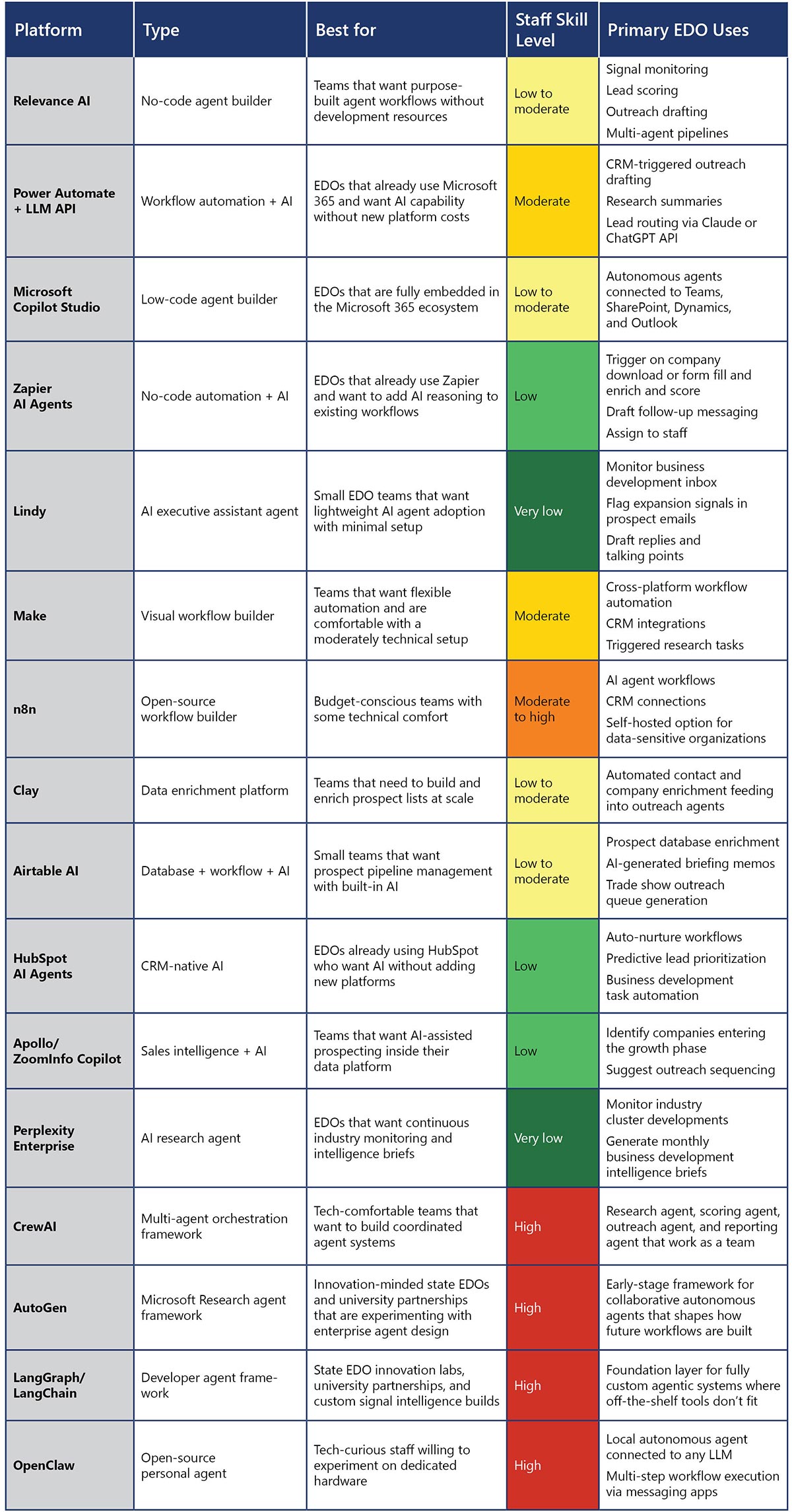
The tools toward the top of this table are where most EDO teams should start. The tools toward the bottom are worth understanding as the landscape develops, particularly for state-level organizations and those with dedicated innovation capacity.
You don’t need CrewAI or LangChain to run a better prospecting program. You need clean data, a documented workflow, and one tool that reliably surfaces warm signals and helps your team act on them faster than the competition does.
Agentic AI doesn’t work on top of bad data or disconnected systems. Camoin Associates is currently helping clients prepare their systems for AI integration, allowing them to layer in agentic AI regardless of what CRM or other software platforms they use.
Three things must be in place before any of this is worth attempting:
An AI agent is only as useful as what it can access. A neglected CRM produces poor outputs at scale, faster than a human could, which makes the problem worse. If your contact records are incomplete or your company data lives in a spreadsheet nobody fully trusts, that’s the first problem to fix.
AI agents need to read from and write to your systems. If your CRM, website analytics platform, and email client don’t communicate, there’s integration work to do first. Automation layers on top of integration, not in place of it.
You can’t automate a process you haven’t mapped. Walking through every step of your prospecting process, who does what, when, and triggered by what, is worth doing even if you don’t plan to use agentic AI. Teams that skip this step end up automating a mess.
The gap in business attraction over the next few years will come down to who finds the right companies first and reaches them with a message worth responding to. For most EDOs, that’s still a mostly manual process.
Agentic AI doesn’t replace the judgment at the center of that work. It handles the parts that don’t require judgment, at a scale and consistency that manual processes can’t match.
If you want to go further, Camoin Associates offers two ways to work with us directly.
For teams that learn best by doing, we offer an AI Workshop that brings your staff through the core concepts, tools, and prospecting applications in a hands-on session tailored to your organization’s current setup and goals.
For leadership teams thinking through how AI fits into a broader organizational strategy, Dillion Roberts and Robert Camoin, CEcD, are available for one-on-one strategy sessions to map out a practical adoption roadmap specific to your program.
To book a workshop or strategy session, please contact me by email at droberts@camoinassociates, by telephone at 518-899-2608, Ext. 110, or on LinkedIn.
If you’re ready to put this into practice, we’ve developed a step-by-step guide for economic developers that will get you there. It covers everything you need to run your first pilot agent, including trade show research automation and BR&E signal monitoring. It features fillable checklists, worksheets, a tool selection framework, and a measurement scorecard.
📍 Related Articles:
Dillion Roberts is the Director of ProspectEngage at Camoin Associates. He has a Bachelor of Science degree in Technology Systems with an emphasis in Technical Management from from Utah State University and a minor in Business Management and Leadership through the Huntsman School of Business. With over 16 years of versatile expertise in project management, sales, marketing, and client account stewardship, Dillion is a seasoned professional adept at fostering economic development and driving transformative change. Drawing upon his extensive industry experience, he goes beyond the conventional, spearheading business attraction initiatives that fuel growth and innovation.

Industry Analytics and Strategy
Following the COVID-19 pandemic, outdoor recreation is no longer in recovery mode and has matured into one of the most significant and durable economic sectors in the country. We take a look at recent trends, opportunities, challenges, and successes in the sector and offer guidance on how to grow your outdoor recreation economy.

Industry Analytics and Strategy
Evaluation and Benchmarking
Your resource for understanding today and looking toward tomorrow