


- Navigator
- Food and Beverage
- Manufacturing
- Expansion Solutions
- Industry Analytics and Strategy
 This article originally appeared in the November/December 2023 issue of Expansion Solutions Magazine.
The food manufacturing sector plays an important role in every economy, providing goods for institutions such as schools and hospitals as well as restaurants and grocery stores for everyday consumers.
There is not a state, region, or locality in the United States where food manufacturing and processing do not have a presence, either directly through a company and associated jobs, or as part of the value chain for the overall food economy, including agriculture, warehousing, and distribution.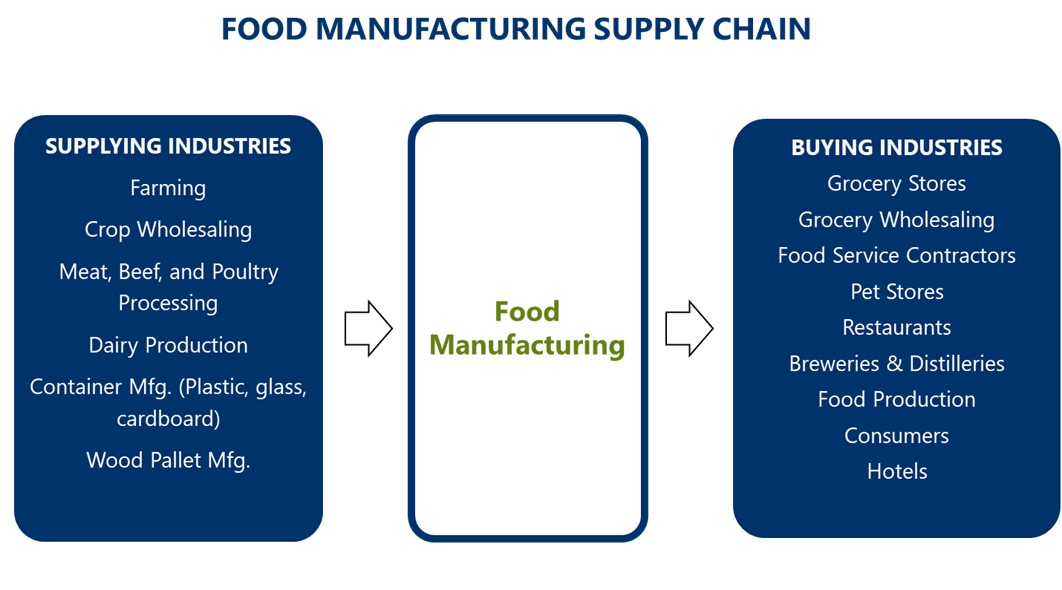 In this article, we focus on food manufacturing and processing as defined by the North American Industry Classification System (NAICS) 311 . We provide an overview of economic trends in the industry, examine recent issues, and provide insight into business expansion and attraction for regional economic development.
In 2022, there were 1.7 million jobs in food manufacturing across the US, representing just over 1% of all jobs in the nation. Economic output as measured by Gross Regional Product (GRP) in 2022 for food manufacturing was $181 billion, also representing just over 1% of economic output for all industries.
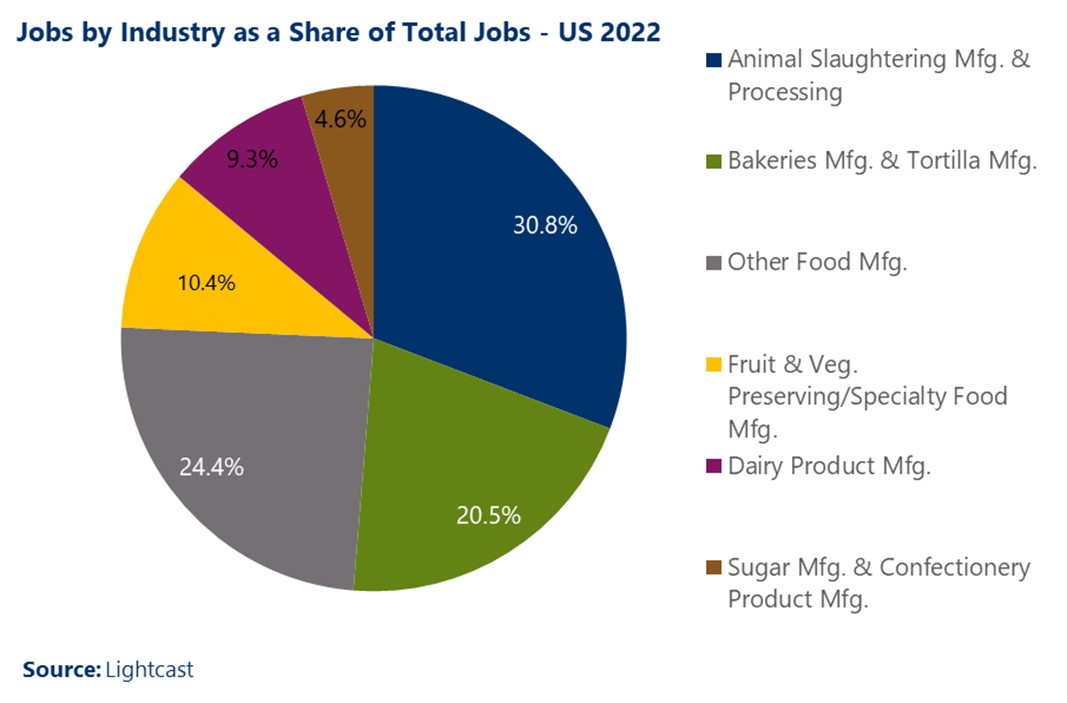
Though a relatively small sector, food manufacturing is growing faster than the economy as a whole. Between 2017 and 2022 food manufacturing jobs grew 6.6% in the US compared to 3.8% for all sectors, with an additional 8% projected growth from 2022-2027, again outpacing the overall economy.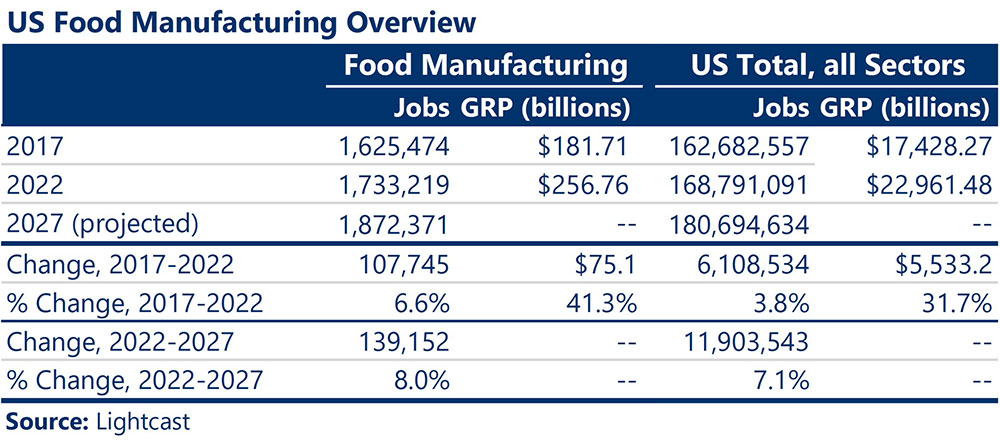 Looking at Food Manufacturing subsectors, Animal Slaughtering and Processing and Bakeries/Tortilla manufacturing together accounted for just over 50% of all jobs.
 Jobs in food manufacturing in the US are most concentrated in the Midwest States as well as Alaska. For example, food manufacturing employment is 3.5 times more concentrated in Nebraska than in the nation overall. Notably, states with high concentrations of food manufacturing also have strong activity in other parts of the food value chain. For example, the Midwestern states have strong concentrations in agriculture, while Alaska’s economy has relatively high shares of employment in fishing. The combination of multiple food sector activities and value chain assets creates an environment for food manufacturing to flourish.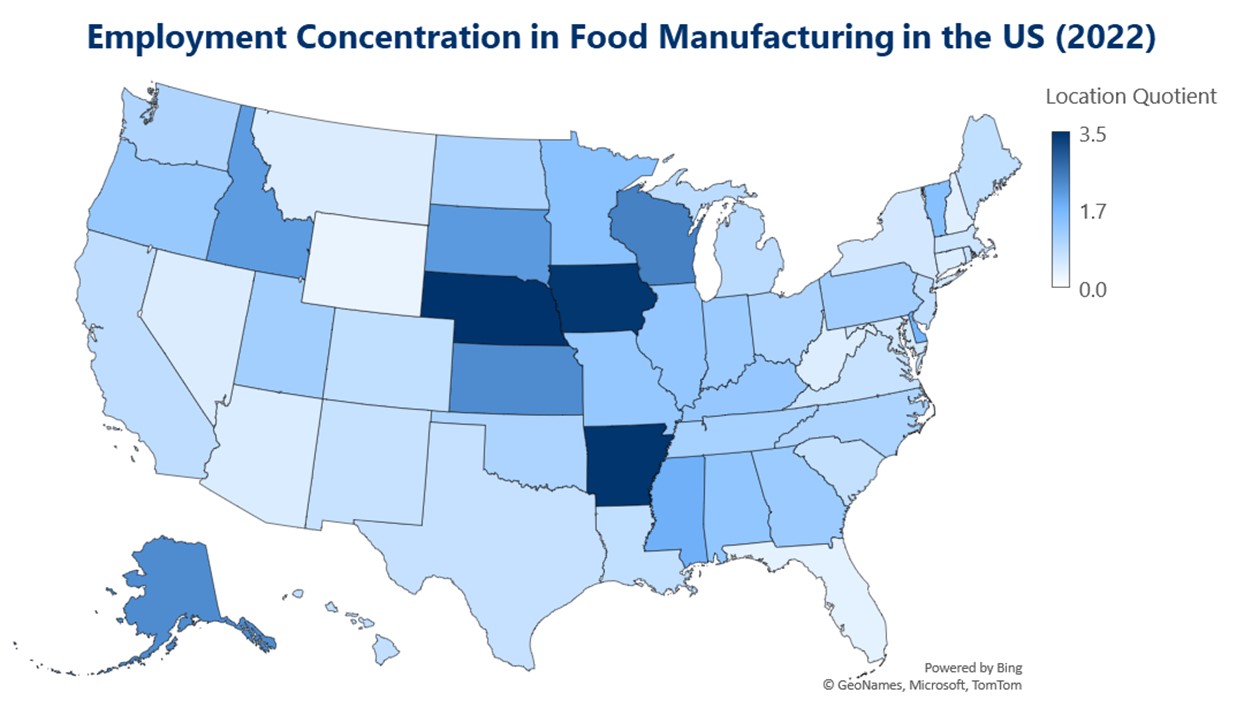
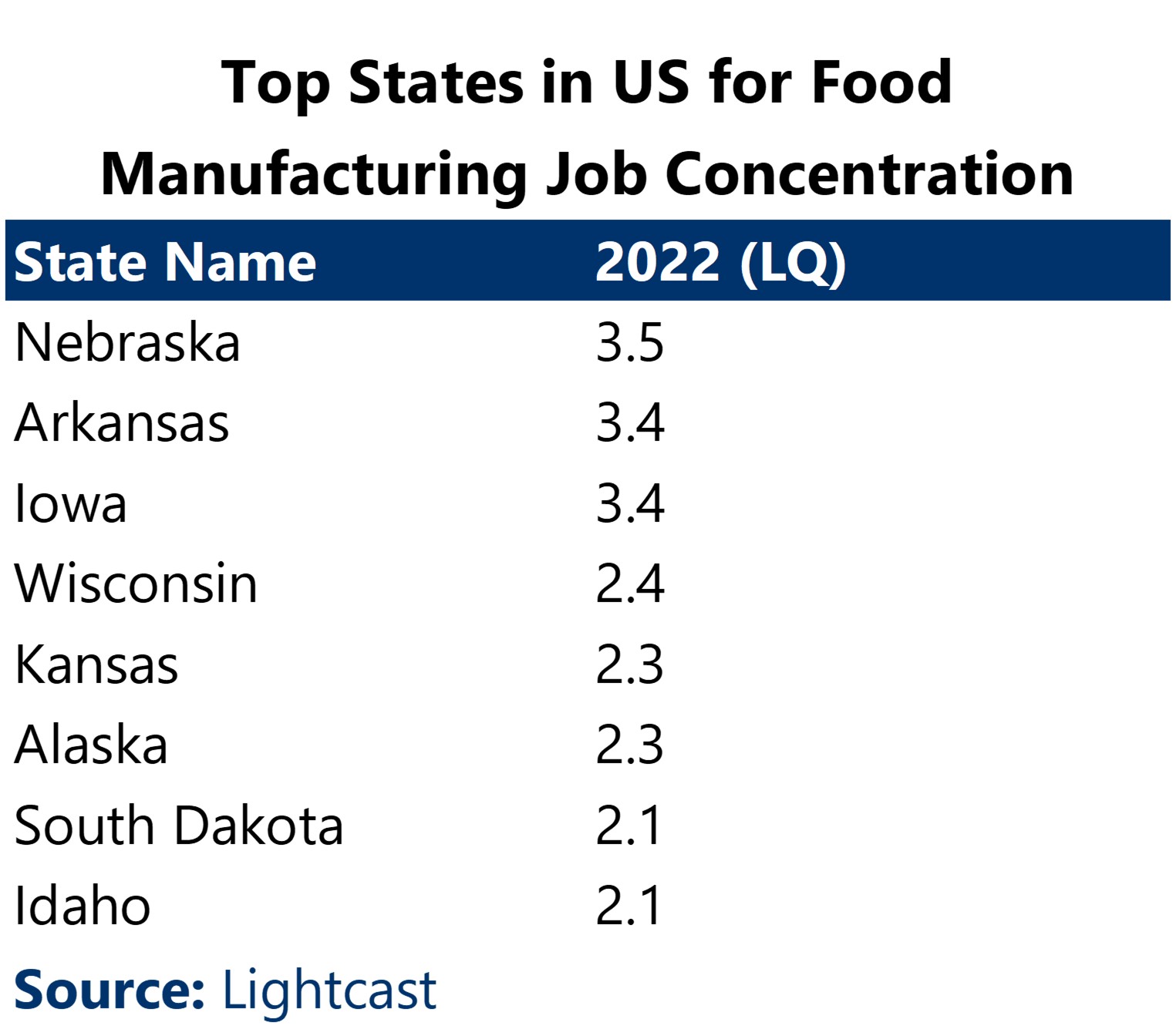 Examples of recent investments in these states include:
While critical and growing in importance to the US economy, food manufacturing jobs provide relatively low earnings at about $70,000/year on average, per job, in 2022 compared to $80,000/year for the economy average. While providing entry-level jobs (those that require little to no education or training) is meaningful, these low wages create challenges for attracting and retaining workers in a highly competitive labor environment.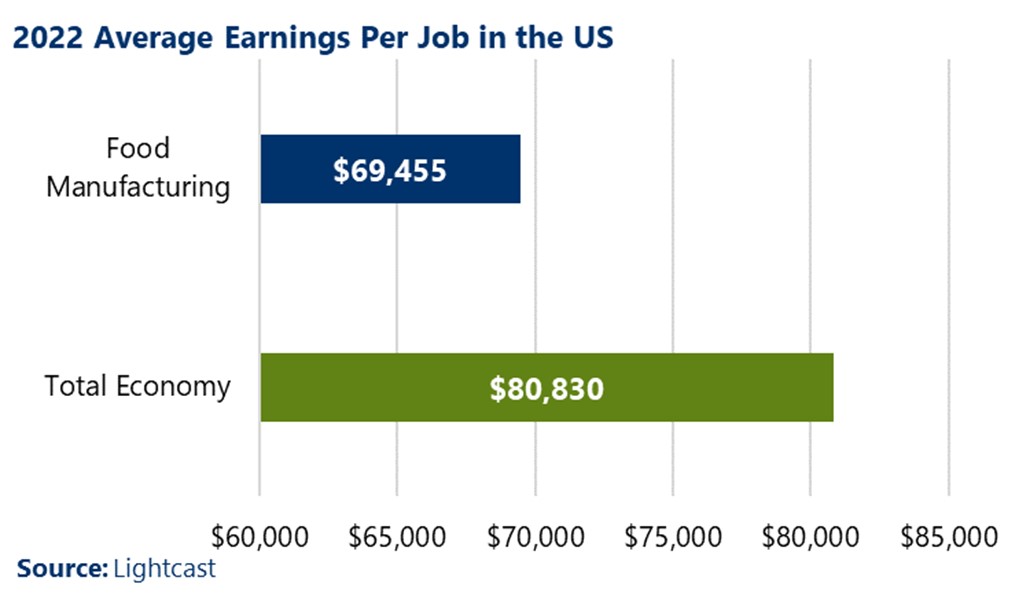
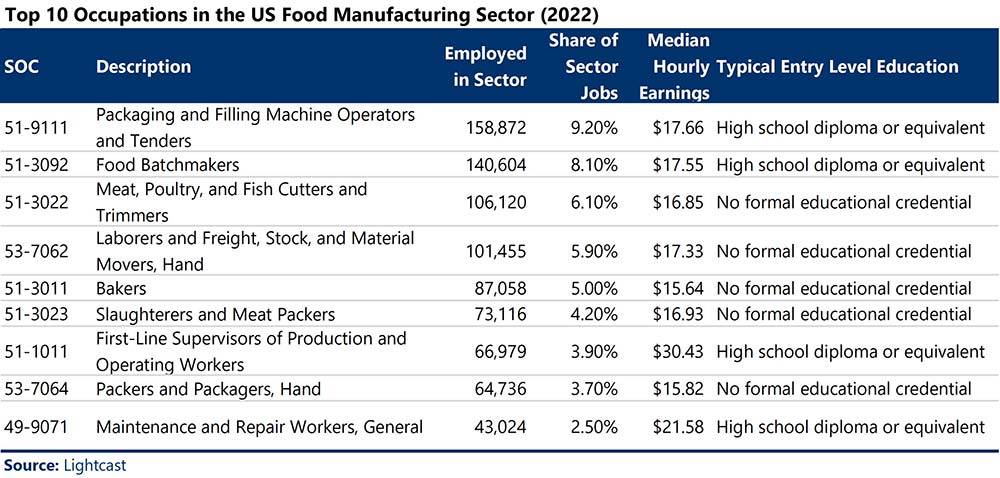
Food manufacturing is being influenced by multiple recent trends and factors including workforce, supply chain, demographics, changing consumer demand, technology, and climate. The following is an overview of three of these and their relationship to the food manufacturing industry.
Food manufacturing and processing is one component of a complex system that makes up the food economy. Economic performance and opportunities in food manufacturing depend significantly on costs and prices in each of the other supply and value chain components as well as policies, practices, and market changes. Over the past five years, we have seen multiple factors impact the food supply chain, each creating knock-on impacts for the food manufacturing sector. These include COVID-19; geopolitical events and disruptions such as the war in Ukraine; climate change and major climate events (floods, fires, hurricanes, etc.); labor disruptions including strikes; and more.
Further growth and stability in the sector will continue to require major investment in upkeep, improvements, and expansion of the underlying infrastructure that supports supply chains and logistics, including roads, rails, ports, canals, and airports. This is required to keep supply chains functioning and to create long-term resiliency to external factors.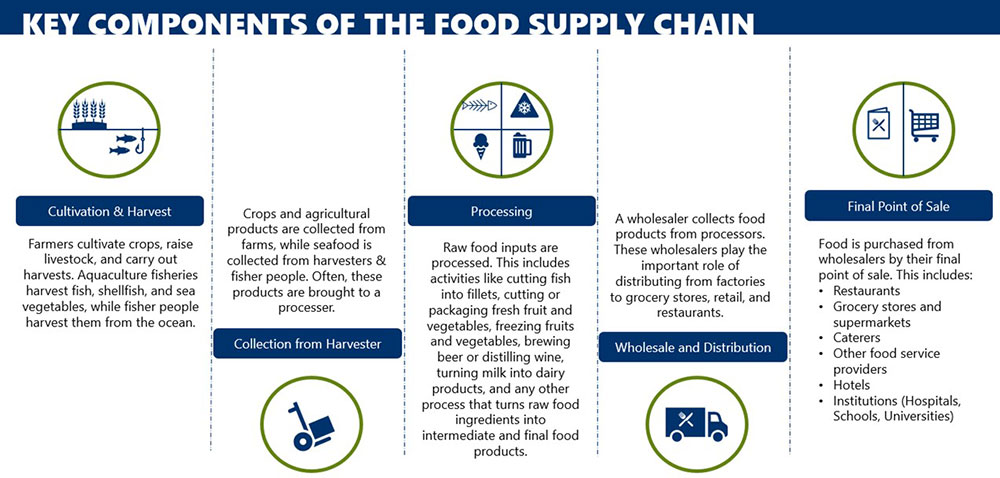
Each of these factors is creating change in the food economy. In the US, the population is becoming more ethnically diverse, which creates new and expanded markets for global ingredients, palettes, and preferences. Meanwhile, Millennials are now the largest generation, creating further change in market preferences.
Other trends such as preferences for convenient food options including grab-n-go, healthy alternatives, plant-based proteins, and local food movements are all creating new opportunities for entrepreneurs and existing companies to satisfy this changing demand.
Digital technology is transforming all industries including food manufacturing. Ecommerce infrastructure and use are creating new opportunities for food manufacturers, including direct-to-consumer ability. This is particularly beneficial to medium and small food manufacturers.
Additionally, the rise of social media use and channels is further fueling this and allowing companies to build “consumer communities.” Finally, technology in the form of automation and robotics combined with software and sensors is transforming how food is manufactured, tracked, and delivered.
Based on these recent trends and issues, there are several key takeaways to help economic and business developers grow the local and regional food manufacturing industry.
Support networks and communities of entrepreneurship and innovation specifically within the food economy. Rapid change and technology require new learning and approaches. Larger companies have access to innovation, R&D, and commercialization that small companies are typically lacking. Entrepreneurial networks and related programs and initiatives can provide shared support for capacity building for entrepreneurs seeking to enter the market along with smaller companies already participating in the market.
Provide data analytics and market intelligence to food manufacturing companies and stakeholders within your state or region. There has been a significant increase in data and analytics applicable to the food industry in the past five years. This includes demographic and consumer trends; data on sales, trade, and logistics that provide important intelligence for focusing on new geographic markets; and digital intelligence of marketing, social media, and branding. Again, all of this is commonly accessible to large corporations but typically out of reach for smaller companies and entrepreneurs, though networks and alliances can help aggregate capacity to provide information and related services.
Provide support for small and mid-sized industries in accessing and preparing for trade shows. Trade shows are beneficial both for learning about issues arising within the industry as well as finding new opportunities for penetrating the market through B2B sales and partnerships. The following is a list of some of the prominent trade shows relevant to food manufacturing.

Real Estate Development and Housing
Housing is essential infrastructure in rural communities, small towns, and micropolitan areas. It shapes workforce stability, economic resilience, and long‑term community viability. Explore case studies, actionable tools, and a step-by-step guide for meeting housing needs in these unique markets.
Industry Analytics and Strategy

Prospecting and Business Attraction
Your resource for understanding today and looking toward tomorrow