


- Navigator
- Industry Analytics and Strategy
- Workforce Development
- Manufacturing

Every day, 13.2 million workers keep America’s manufacturing engine running—supporting jobs, innovation, and advancing US competitiveness.1 While the industry remains a cornerstone of the US economy, it is in the midst of profound change, with automation, global competition, and efficiency gains reshaping the roles available to workers at all stages of their careers.
While there are numerous factors contributing to shifts in the size of the labor force, the result of these shifts has led to a drastic increase in competition for talent with specific skillsets. When combined, this workforce competition and the quickly evolving nature of manufacturing leave employers with a growing chasm known as the “workforce gap.”
Because of the changing nature of manufacturing positions, career pathways and in-demand skills are evolving, as are the tactics manufacturers are using to offer upskilling or training opportunities in-house.
In many industries, entry-level positions serve as a stepping stone into the professional world, potentially shaping a long-term career path. While it is less common now to follow a single career track than it was 60 years ago, these roles still open doors for workers to find their footing and start gaining specialized skills.
However, the positions that once helped workers get their start are declining. Leading labor market research from Lightcast shows that traditional entry-level roles have shrunk significantly over the past decade in the manufacturing industry.
Intelligence from Lightcast reports that between 2014 and 2024, roles like Helpers-Production Workers decreased by 53% (-140,000 jobs), Machinists by 21% (-69,000 jobs), and Packers and Packagers, Hand by 18% (-32,000 jobs). These three jobs traditionally provided a steady path into higher-value roles, but automation and process redesign have reduced the need for workers in these positions.
Additionally, many of the remaining entry-level jobs require specialized skills that many workers lack. Consequently, fewer workers are entering the manufacturing workforce through entry-level feeder roles.
Evaluating the characteristics of the most common occupation in manufacturing can shed light on evolving career paths for the typical manufacturing worker. Lightcast reports that Miscellaneous Assemblers and Fabricators make up more than 1.1 million jobs in manufacturing (8.6% of all industry employment) and grew the most of any occupation in manufacturing between 2014 and 2024, adding over 151,700 positions.
Assemblers and Fabricators earn a median wage of $20.27 per hour, typically requiring only a high school diploma and moderate on-the-job training. This role builds fundamental competencies in manufacturing processes, such as reading technical drawings, following production sequences, and conducting quality checks.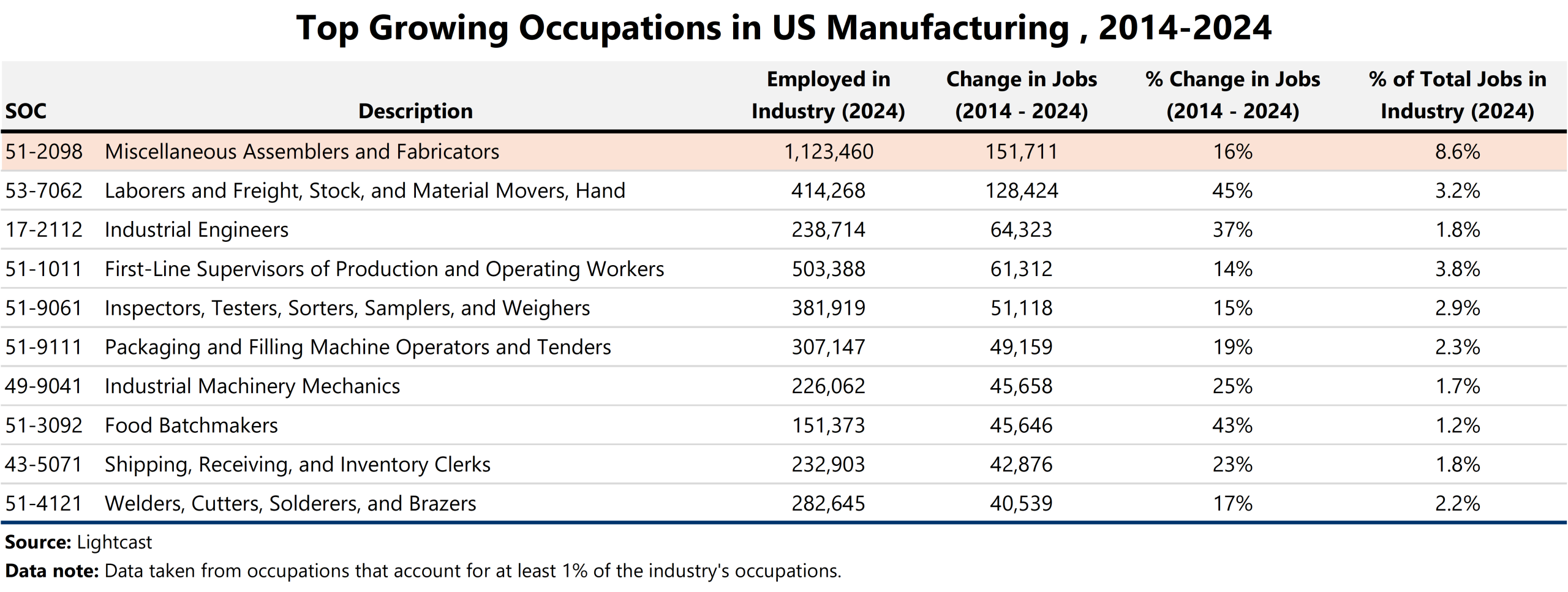 Assemblers and Fabricators have several potential career trajectories to follow, based on their education and the subsector in which they work.
With additional technical training or upskilling, workers can progress into more technical roles, such as Industrial Engineering Technologists and Technicians. Making this move offers an average annual salary boost of more than $10,000 for those who make the transition.
A typical next-step occupation is First-Line Supervisors of Production and Operating Workers. These roles typically require less than five years of experience rather than advanced degrees, making them a critical bridge for upward mobility.
Source: Lightcast, Camoin Associates
View Career Pathway graphic as a PDF
This trajectory could be a fit for some workers, but it is becoming increasingly important to rethink traditional career pathways. Linear, predefined routes may have long been the norm, but today’s rapidly evolving environment demands more flexibility. Employers are beginning to seek talent based on core aptitudes and transferable skills (that could have been acquired in other industries) rather than a perfect skill match from the start.
With technologies and processes changing so quickly, the skills needed today may be outdated tomorrow, making on-the-job learning and “adaptive skills” a critical component of a worker’s skillset. Industry intelligence demonstrates that manufacturers value adaptive skills like:
Prioritizing aptitude and adaptability over a specific skill in the hiring process can support a worker’s career path and open up new opportunities outside of a narrow pathway focused on technical skills.
EY’s industry report found that adaptive skills were beneficial not only to the employee’s personal outcome but also to the companies themselves, which were more competitive and able to jump-start growth through this adaptive process.
In response to these shifts, many manufacturers are redesigning their approach to training and incorporating distinct training modules for in-demand skills.
Across Camoin Associates’ client engagements and conversations, we hear from thousands of executives on an annual basis who are testing out new processes in real time to adapt to the challenging workforce environment.
Examples of recent activity that we’ve discussed with companies from across the country include:
With entry-level feeder roles disappearing, the burden of skill development has shifted away from “learning by doing” toward more structured training, like those listed above.
This reality was echoed in Camoin Associates’ recent survey of the State of Maine’s manufacturing workforce, where both current and potential workers emphasized that training availability directly shapes their decision to stay or enter into the industry.
Among current workers who answered the survey, a key concern about remaining in the industry was limited career growth due to insufficient training or skills development (27%). At the same time, most reported having access to at least some training opportunities, and 70% said that the amount of internal training that was available was either “good” or “fair”.
Current workers also identified additional training needs, highlighting areas such as coding, laser alignment, and tug welding.
Potential workers who completed the survey pointed to the lack of relevant training and education as a barrier to pursuing careers in advanced manufacturing. They emphasized that expanding training and education opportunities would increase the industry’s appeal and make them more likely to consider entering the field.
While the survey provides just a snapshot of one region, the responses highlight that many locations do not offer enough technical skills training to meet the workers’ needs.
Taken together, labor market data and worker perspectives point to the same conclusion: reskilling and upskilling are essential for both retaining today’s workforce and attracting the next generation of workers.
Survey respondents made clear that training opportunities influence whether they remain or enter the industry, while labor market trends show fewer entry-level roles and more demand for technical expertise.
This creates both a challenge and an opportunity for employers. By investing in short-term training, certifications, apprenticeships, and employer-led programs, companies can provide the technical and supervisory skills that workers need to grow.
Those who build adaptable, comprehensive training systems will strengthen their workforce pipelines and secure a long-term competitive edge in the manufacturing sector.
This article was originally published on the Manufacturers Alliance website on September 25, 2025.
1 Employment figure derived from Lightcast run 2025.3. Generated from NAICS codes 31-33.
Bridget Byrnes is an Economic Data and Research Analyst at Camoin Associates. She holds a Bachelor of Arts in Writing from Emerson College and a Master of Public Administration with a concentration in economic development from Murray State University. As an analyst, Bridget leads data-driven research and strategic planning initiatives across housing, industry, and economic and fiscal impact projects. She has guided efforts ranging from housing and market analyses in communities across the Northeast to cluster and workforce analyses that help regions position themselves for long-term competitiveness. Bridget works closely with local leaders to translate complex economic and demographic data into actionable strategies that support inclusive growth and sustainable development.
Dillion Roberts is the Director of ProspectEngage® at Camoin Associates. He has a Bachelor of Science degree in Technology Systems with an emphasis in Technical Management from from Utah State University and a minor in Business Management and Leadership through the Huntsman School of Business. With over 16 years of versatile expertise in project management, sales, marketing, and client account stewardship, Dillion is a seasoned professional adept at fostering economic development and driving transformative change. Drawing upon his extensive industry experience, he goes beyond the conventional, spearheading business attraction initiatives that fuel growth and innovation.
Alexandra Tranmer, CEcD, is the Director of Industry and Workforce at Camoin Associates. She has an Honors Bachelor of Arts degree and a Master of Science degree in Planning (MScPl) from the University of Toronto in Ontario, Canada. As a senior project manager, Alex has led complex strategic planning efforts in geographies ranging from bustling urban centers to pastoral tourist destinations, requiring adept stakeholder management and collaboration. She works with clients to balance the competing interests of stakeholders while ultimately helping them develop an ambitious yet achievable plan under their current organizational climate.
📍 Related Article:

Real Estate Development and Housing
Ready to move your community forward? Discover how tailored market analysis and strategic public investments can unlock new development.

Industry Analytics and Strategy

Industry Analytics and Strategy
Your resource for understanding today and looking toward tomorrow