


- Navigator
- Real Estate Development and Housing
 Real estate market analysis is often used to answer a straightforward question: What type of development can the market support today?
For economic and community development organizations (EDOs), the more useful question often is: Where do we want the market to be, and what actions will move it there?
A strong real estate market analysis helps communities understand:
It can support decisions about land use, infrastructure, business attraction, redevelopment, incentives, and public-private partnerships.
But market analysis should not be treated as a simple yes-or-no exercise. This is especially important for rural communities, small cities, and emerging markets where development may not happen on its own.
In these places, the market may not yet support the type, scale, or pace of development the community wants. That does not mean the vision is wrong. It means the community needs to understand what is standing in the way and what can be done to change the conditions over time.
Market analysis is sometimes misinterpreted as a set of constraints. In practice, it should be read as a baseline assessment that answers these questions:
With the right real estate market analysis, economic developers can actively push the market toward stronger future opportunities. That means grounding strategy in current conditions while defining clear, achievable actions that move the market in the community’s desired direction.
Many communities find themselves in the same place: clear economic goals, but limited market response. They want to grow and diversify, attract new industries, or support business expansion, and yet developers remain cautious, and projects fail to move forward on their own.
In these cases, waiting for the market to “catch up” rarely works.
This is where real estate market analysis matters most—not to lower expectations or rule out possibilities, but to understand what’s holding the market back and which public sector levers can realistically help move it.
Those levers might include:
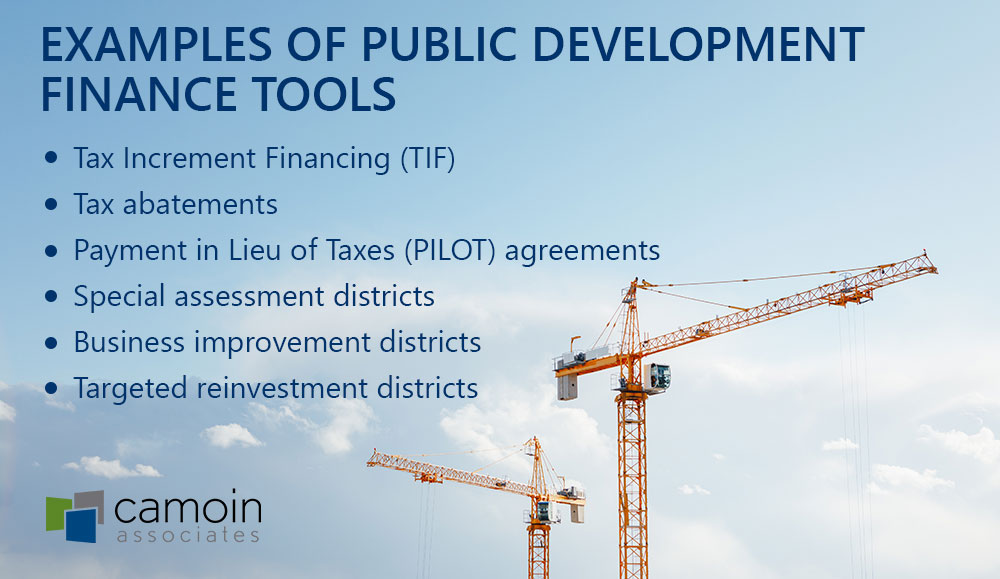 Catalyzing development takes time. Economic developers are often the only people with both the patience and persistence to work on that timeline.
 Building Readiness in a Softer Market
In White Creek, the market did not point to immediate, large-scale industrial or commercial demand. Absorption was expected to be slow, and large speculative projects were unlikely to succeed in the near term.
However, the analysis showed that growth was not off the table. The stronger opportunity was for smaller, right-sized buildings that aligned with local agribusiness and light industrial demand. The primary constraint was not a total lack of interest, but infrastructure and site-readiness gaps that made development harder to advance.
In practice, this pointed to a public sector role focused on preparation rather than forcing the market. That could include:
The takeaway is that in softer markets, public investment can help create the conditions for development so that when businesses are ready to expand, the community is ready to receive them.
 Stronger Markets Still Need Guidance
In Gaithersburg, the market was stronger, but the analysis showed that demand still needed to be managed carefully. Some types of development were feasible, but not everywhere, not all at once, and not on an unlimited scale.
The community faced constraints related to aging commercial space, infrastructure capacity, land availability, redevelopment costs, and competition among uses. At the same time, federal government downsizing created uncertainty for the Life Sciences sector, which is closely tied to the region’s federal presence, research assets, and broader innovation economy.
In practice, the City wanted to use the market analysis to inform its comprehensive plan and better understand how to guide future growth. The findings indicated they needed to:
The goal was not to slow growth, but to help the City make clearer decisions about where new investment should go, how existing commercial areas could be repositioned, and what public sector actions would support long-term competitiveness.
For economic developers, the value of market analysis is not just in understanding what the market will support today, but in using that information to shape a practical path forward.
Do you have real estate you are ready to reposition, revitalize, or prepare for future development? A market analysis can help you understand what the market is likely to support, where the strongest opportunities exist, and what public sector actions can help move projects forward.
The key is identifying the specific gap, whether it is unmet demand, high construction costs, infrastructure needs, outdated buildings, zoning misalignment, limited developer interest, or financing risk. Once the challenge is clear, communities can choose the right tools to address it.
For EDO boards, market-grounded but future-oriented strategies support better governance. Boards can:
The board’s role is not just to ask, “Is this feasible today?” It is also to ask, “How will what we do today change what is feasible tomorrow?”
Real estate market analysis is most powerful when it is used as a decision-making tool, not a limiting document. It helps communities understand where the market stands today, where private investment is likely to occur, and where public action may be needed to close the gap.
The market may not always be ready for the community’s full vision today. But with the right tools, partnerships, and investments, economic developers can help move the market closer to that vision over time.
Do you want to take the next step in preparing a market analysis? Camoin Associates can help.
Learn about our Real Estate Market Analysis and Development Strategy services
📍 Related Articles:
Victoria “Tori” Conroy is a Senior Project Manager at Camoin Associates, where she manages a wide variety of client projects, including in-depth target-industry strategies, economic and fiscal impact analyses, real estate market analyses, and the development of TIF/DIF funding districts. Before joining Camoin Associates, Tori worked for several economic development authorities and has experience managing publicly owned industrial properties, building community partnerships to support workforce development, and developing and executing business retention and expansion programs. She has also led and implemented business attraction campaigns nationally and abroad. Tori has a Master of Public Administration degree and a graduate certificate in local government management from Virginia Tech, as well as a B.A. in Political Science from Virginia Commonwealth University.
Photo Credits:
“White Creek Historic District Christopher Allen House” and “White Creek Historic District John Allen House” by Doug Kerr are licensed under CC-BY-SA 2.0. Both original images have been cropped.
“Center White Creek Baptist Church NY” by Kenneth C. Zirkel is licensed under CC BY-SA 4.0. The original image has been cropped.

Industry Analytics and Strategy
Following the COVID-19 pandemic, outdoor recreation is no longer in recovery mode and has matured into one of the most significant and durable economic sectors in the country. We take a look at recent trends, opportunities, challenges, and successes in the sector and offer guidance on how to grow your outdoor recreation economy.

Industry Analytics and Strategy
Evaluation and Benchmarking
Your resource for understanding today and looking toward tomorrow