


- Navigator
- Industry Analytics and Strategy
- Information Technology, Semiconductors, and AI
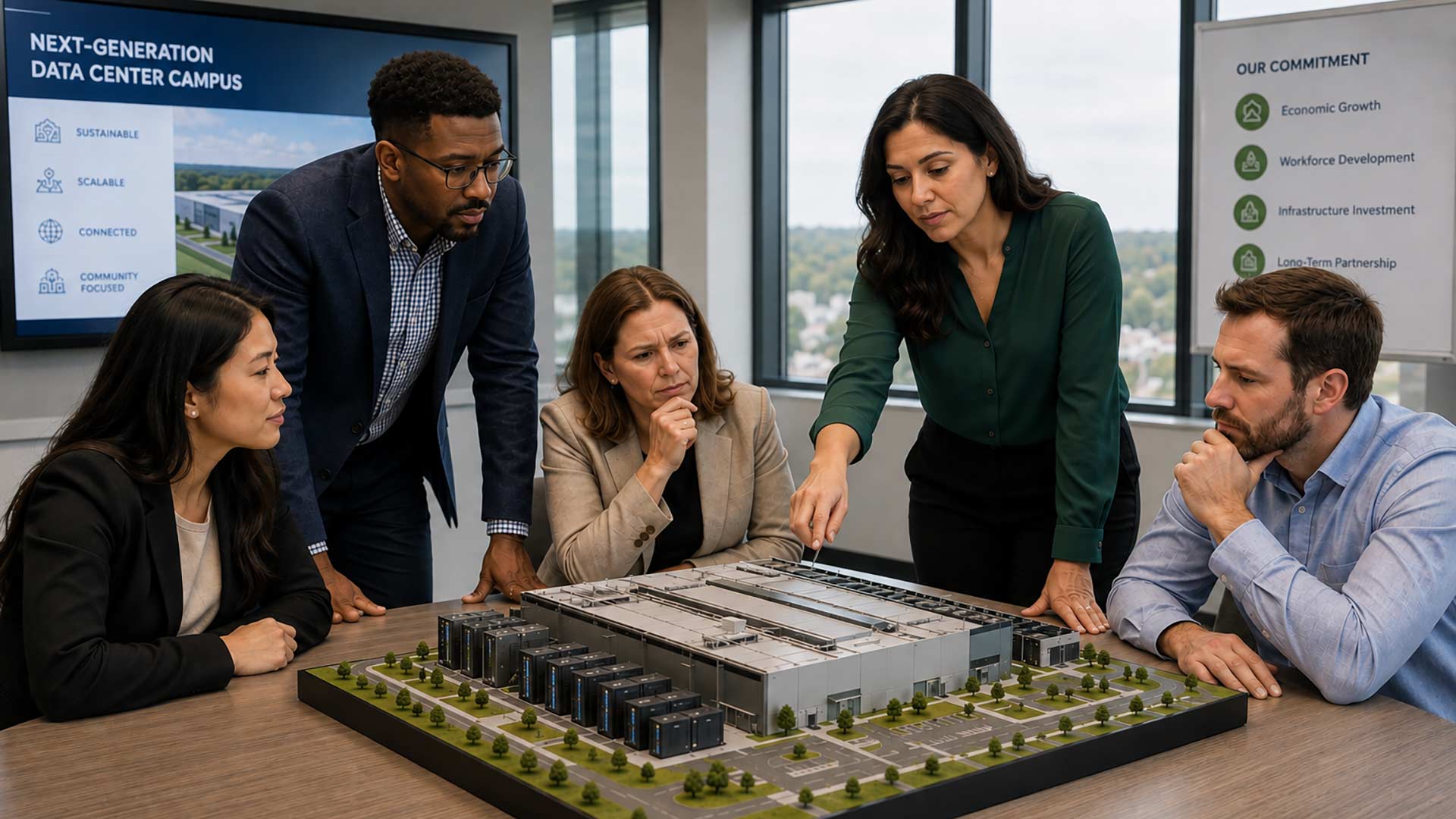 Welcome to the third and final article in our three-part series on data centers and economic development. In our first article, “Data Center Demand and What it Means for Your Community,” we covered what data centers are, the different types of facilities, and trends in supply and demand.
In our second article, “Siting and Building Data Centers: What Economic Developers Should Know,” we explored the critical factors that determine data center site location and what some industry players are doing to mitigate public concerns as sites are chosen.
In this article, we offer practical tips and tools to help your area consider, plan for, and act on data center opportunities that align with your local and regional economic development objectives.
As indicated in our previous article, data center growth is increasing significantly, and project proposals are ramping up across the country. In this environment, it is better to plan and prepare rather than be reactive.
In other words, don’t wait for a proposal to come forward. Get out and begin planning and preparing now. This is true regardless of whether you initially want to allow and support data center development or to limit it.
There are five actions community leaders take to be proactive.
To begin these conversations, communities can host public conversations and workshops to help residents better understand what data centers are and explore their potential impacts on the economy, the community’s fiscal conditions, the natural environment, and other social implications. The goal of these meetings is to establish community priorities for new data center development.
We recommend keeping these community conversations open and transparent. Provide copies of additional resources that people can dig into afterward.
It is often beneficial to invite local and regional partners who may be having similar discussions about data center development to attend meetings. You may also want to invite outside experts who can help answer questions and advise on specialized subject matter.
Once your community priorities are established, it is critical that your elected officials, boards, and staff have the capacity to properly vet data center proposals and, if desired, set expectations for how development will occur.
This will require setting aside time and resources to plan and facilitate a thorough process to make informed decisions. It includes defining objectives and roles of staff, advisory committees, and decision-making committees/boards.
Because of the specialized nature of data centers, this internal vetting is likely to take longer than the typical planning review process, and adequate time should be allocated to properly consider aspects of the proposal.
Land-use and zoning codes are typically the best way communities and regions can influence whether and where data center development occurs and at what scale.
Updates to land use regulations may include:
Water and energy capacity are typically the biggest infrastructure impacts from data centers, and will require detailed planning and negotiations with utility providers and potentially state-level regulators.
Related assessments that may also be necessary include:
Communities should proactively assess and prioritize potential data center sites based on both technical feasibility and community goals. This evaluation can be integrated into broader industrial and commercial site-readiness efforts, helping identify where data centers may be an appropriate fit while also preserving key sites for manufacturing or other priority development.
Establishing these priorities before a proposal is submitted provides greater clarity for developers and helps align future investment with the community’s long-term economic development vision.
If your community determines that data centers are an appropriate fit, the next step is to think strategically about how they can generate broader economic and community benefits.
Rather than viewing a proposal as simply a “yes or no” decision, communities can establish policies and expectations that maximize local value—from workforce and contractor participation to fiscal returns and long-term economic development.
The strategies described here are most effective when they are identified before a data center development proposal is on the table.
Potential strategies include:
For communities that have determined data centers align with their long-term vision, these facilities may serve as anchors for broader technology-based economic development.
In some cases, communities may also be able to negotiate opportunities to expand fiber infrastructure or provide access to computing resources in the education system, where feasible. This may be particularly relevant in rural areas.
According to the Pew Research Center, roughly two-thirds of the more than 1,500 proposed data centers are located in rural communities, compared with nearly 90% of existing data centers in urban areas, highlighting a shift in where future investment is occurring.
For rural communities that have identified data centers as an appropriate land use, this investment may also accelerate broadband expansion and strengthen digital infrastructure that supports future economic growth.
Example: In the Atlanta region, public, private, and nonprofit partners worked together to leverage Microsoft’s investment to expand economic opportunity beyond a data center itself.
Through a partnership between Microsoft and The Same House, six local organizations received funding to increase digital skills training, AI literacy, and access to workforce and entrepreneurship opportunities, demonstrating how strategic collaboration can amplify the community benefits of private investment.
Across Camoin Associates’ recent conversations with businesses about data center development, one theme has emerged consistently: The primary barrier to expansion is often not market demand, but access to sufficient electric power.
As electricity needs continue to grow, communities that invest in energy infrastructure will be better positioned to support a wide range of industries, not just data centers.
Because data centers require significant electrical capacity, they can drive investments in substations, transmission lines, and grid modernization.
Communities should consider how these infrastructure upgrades could support broader economic development goals by increasing capacity for existing businesses and making additional sites viable for manufacturing, technology, and other energy-intensive industries.
Data centers create significant workforce demand during both construction and operations. While permanent operational employment is typically smaller than construction employment, the industry relies on a wide range of skilled occupations, including electricians, HVAC and plumbing technicians, construction trades, equipment and network technicians, engineers, facilities managers, and operations supervisors.
Rather than developing workforce initiatives solely for data centers, communities should use this demand to strengthen credentialing programs that also serve manufacturing, utilities, advanced technology, and other industries with similar talent needs.
Example: With the Rio Grande Valley Broadband Coalition, the City of Pharr, TX, brought together a group of community organizations to determine the best methods for negotiating a Public Benefit Agreement with data center developers. As Texas continues to be a hotbed of data center development activity, these conversations are critical.
Data centers may provide a viable redevelopment opportunity for sites that have historically been difficult to reposition for new investment. This can include brownfields, retired power plants, former military installations, vacant manufacturing facilities, and other large industrial properties.
When strategically aligned with community goals, redeveloping these underutilized properties can return dormant assets to productive use and generate new tax revenue.
Your community priorities and the strategies described above can guide discussions with developers and, where appropriate, be formalized through a community benefits agreement (CBA) or other development agreements.
CBAs can take many forms and may be tied to development approvals, incentive packages, or negotiated as part of the overall development process. Their purpose is to create a legally binding commitment that ensures a project delivers specific public benefits identified and agreed upon by both the community and the developer.
For data center projects in particular, early and transparent discussions are essential. In some communities, limited public information about a project’s operations or long-term impacts has made it difficult for local governments to negotiate meaningful community benefits.
Establishing expectations early in the planning process gives communities a stronger foundation for these discussions.
CBAs can also address project-specific impacts by establishing performance standards or mitigation measures for issues such as:
Your community priorities and any strategies you pursue should also be incorporated into your community’s broader economic development and business expansion strategies, ensuring that your community’s investments in data centers create lasting value for the regional economy.
While there is no one-size-fits-all approach to the data center question, the most successful communities will be those that proactively define their priorities before development opportunities arise.
The questions explored throughout this guide are not unique to data centers. They are equally valuable for evaluating other large-scale industrial and technology investments driven by changing supply chains and shifting geopolitical norms.
Camoin Associates partners with communities to navigate these complex decisions through objective analysis and data-driven evaluation. Whether your community is considering its first data center proposal or developing a long-term strategy for technology-driven economic development, we can help you build the framework needed to make informed decisions that create lasting economic value.
Learn more about our industry analytics and strategy services
Jim Damicis is Senior Vice President at Camoin Associates. He has more than 30 years of experience using research and analysis to help professionals, communities, regions, states, and public and private organizations prepare for an emerging economic future. He has led a variety of projects at Camoin Associates, including local and regional economic development strategies, targeted industry analysis, workforce development, innovation economy, and evaluation and benchmarking. Jim is the former President of the Northeast Economic Development Association (NEDA) and has served in leadership roles for more than 10 years. He serves on the Federal Reserve of Boston’s New England Public Policy Advisory Committee and is an instructor for the International Economic Development Council’s (IEDC) annual strategic planning course. Jim is also a collaborator with Communities of the Future, focusing on economic transformation. He holds a Master of Public Policy and Administration degree from the Edmund S. Muskie School of Public Service at the University of Southern Maine and a Bachelor of Arts degree in Economics and Political Science from the University of Connecticut, Storrs.
Alexandra Tranmer, CEcD, is the Director of Industry and Workforce at Camoin Associates. She leads data-driven economic development strategies that help communities understand where they are competitive and how to act on that insight over the long term. Based in Upstate New York, Alex has spent more than a decade working with communities across New York State and throughout the country, from small rural regions to fast-growing metropolitan areas. She has published recent articles in Expansion Solutions and the Manufacturers Alliance blog, covering topics including life sciences, advanced manufacturing, and semiconductors. A trusted advisor to her clients, Alex frequently remains engaged beyond initial planning efforts to support implementation, adaptation, and long-term success.

Industry Analytics and Strategy
Following the COVID-19 pandemic, outdoor recreation is no longer in recovery mode and has matured into one of the most significant and durable economic sectors in the country. We take a look at recent trends, opportunities, challenges, and successes in the sector and offer guidance on how to grow your outdoor recreation economy.
Industry Analytics and Strategy
Evaluation and Benchmarking
Your resource for understanding today and looking toward tomorrow